Add your promotional text...
Why Oil Palm is a Good Choice for Hawaii
Background
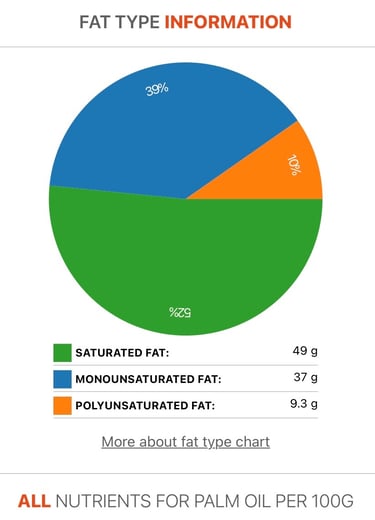
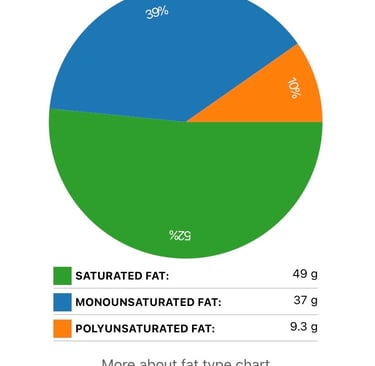
Oil palm has been producing oil for human civilizations for over 5,000 years. Oil palm produces more oil per acre than most other crops cultivated for oil. For example, soybeans, a major source of oil grown in the American Midwest, produces 60 gallons/acre while oil palms produce almost ten times as much per acre (5). By 2013, palm and kernel oil produced 32% of the world’s edible bio-oil production feeding more than a third of the world’s population (see red palm oil on the web). Globally, palm oil is now the leading vegetable oil for human consumption. According to FoodStruct.com, 100gm of palm oil provides the daily requirement for Vitamin E, a healthy dose of Vitamin K, a dash of choline, a B-vitamin, and has less saturated fat than coconut oil.
The choice of hybrid oil palms is not an accident. Over the past century, research into improving production and quality has concentrated mostly in SE Asia, Indonesia, Malaysia and Central America. This research has given rise to breeding new hybrid strains that take advantage of genes for high productivity, cold tolerance for higher elevation and dwarfism. Attempting to them in Hawaii at 19-22 degrees latitude N was perceived as a risky proposition. Dr. Steiner decided to try hybrids with cold hardiness genes for higher elevations, equating high elevation with high latitudes. The gamble worked as oil palm trees took off on Hawaii Island.
Opportunities for Hawaii
The destruction of large swaths of ancient forests and its animals in SE Asia for huge oil palms plantations has given the crop a very negative reputation. The subsequent loss of biodiverse ecosystems to create vast monocultures of oil palms plantations is unconscionable, but it is not the fault of the tree. Rather, the greed of corporate landowners has driven this kind of agricultural model. However, HOSPRO envisions a very different means of production in Hawaii that would enhance, not destroy, the life of the land and the species that rely on it.
A palm oil industry can do many good things uniquely suited to Hawaii’s residents and economy: improve Hawaii’s fuel and food security; create a sustainable, circular bioeconomy; and lower Hawaii’s carbon footprint. Literally billions of dollars can remain in Hawaii’s economy each year building resilience and sustainability by generating new industries, jobs, businesses, and reducing susceptibility to offshore collapse of economic systems and supply chains.
Biofuel is not the only thing E. guineensis hybrids can provide. Its oil can also be used in the manufacture of soap, candles, plastics, cosmetics and pharmaceuticals, opening up new industry opportunities for Hawaii. When the pulp oil is made into an edible oil, it is used in the manufacture and processing of hundreds of food products from cereals to chips to pizza dough and cookies. Its kernel oil can be made into a fine machine oil for lubrication purposes. The byproducts from producing these oils include a meal that can be turned into a high protein, nitrogen supplemented feed source for the local cattle and swine industries. Creating an animal feed industry would allow Hawaii to produce more of its own meat and dairy, thus again reducing need for imports (7). Even the green waste left from harvesting can be turned into Biochar for a soil enrichment supplement that also stores carbon. On top of all this, the byproducts of these industries can be useful to make composts for gardens and growers, feed oil palms, or ferment into ethanol for sustainable aviation fuel (SAF).
Hawaii has thousands of acres of underutilized and depleted agricultural land, actually its most valuable natural resource;
Native ecosystems need not be destroyed here because thousands of other empty acres have turned into reservoirs of invasive species (a contributing factor in the 2023 Lahaina fire), and are in need of restoration into either integrated agriculture or native habitats;
Rather than developing yet another extractive monoculture agricultural system, oil palm cultivation can be integrated with grazing animals, shade-tolerant crops such as coffee and cacao, and/or a leguminous ground cover to improve soil quality; this multi-cropping system will allow small farmers to reap greater profits from their land;
With this integrated agricultural system: fallow agricultural lands can be put back into production; small landholders can make greater profits; and depleted soils and damaged ecosystems can be restored;
The sustainability of an oil palm industry is enhanced by the fact that the trees do not require heavy uses of phosphate and potassium fertilizers, thereby reducing imports and costs to farmers;
Production tests in 2017 have proven oil palms in Hawaii would produce 620-650 gallons oil/acre well above the global average of 602 gallons/acre; soil enrichment may increase these numbers;
USDA statistics show small farmers in Hawaii are barely scraping by on half the income required by a family of four; cultivation of oil palms could be integrated into existing crops and greatly increase their income, enabling them to remain on their land.
Palm oil can be used to make bio products, such as bioplastics, biofibers, soap, cosmetics, etc. Livestock can graze alongside oil palms as part of an integrated agricultural production system. Shade-tolerant crops such as cacao, tea, and coffee, along with leguminous ground cover to improve soil quality, all can be a part of this integrated system. Hawaii benefits by not only increasing production of commodity crops like coffee and cocoa but also by simultaneously offsetting imports of petroleum, cooking oil and animal feed.
Reducing Global Carbon
Hawaii generates about 20-22 million tons of CO2 annually, not including aviation and the Kilauea Volcano. There is currently no way to offset these carbon emissions. Four recent studies from disparate regions of the globe show that, on average, oil palms store up to 30 tons of carbon per acre. Even more can be stored if biochar — made from invasive or dying trees and other green waste — is used as a soil supplement to promote oil palm growth. While this, in and of itself, is a good thing, a global carbon credit market began developing in 2021 in efforts to quantify and reduce carbon emissions. The value of provable carbon credits is expected to rise as airlines are looking for ways to offset their carbon emissions on flights to Hawaii. They are now negotiating with mainland SAF suppliers and are actively looking for ways to offset their emissions with SAF produced in Hawaii for their return flights. Selling carbon offset credits would not only be a substantial boost to HOSPRO and farmer income, but would also strengthen Hawaii’s economy, sustainability and conservation practices.
In Sum:
Empowering farmers for a resilient bioeconomy in Hawai’i.
Contact Information:
© 2025. All rights reserved.
Hospro@hawaiioilpalm.org
200 Kanoelehua Ave #205
Hilo HI 96720
Hawai’i Oil Seed Producers, LLC